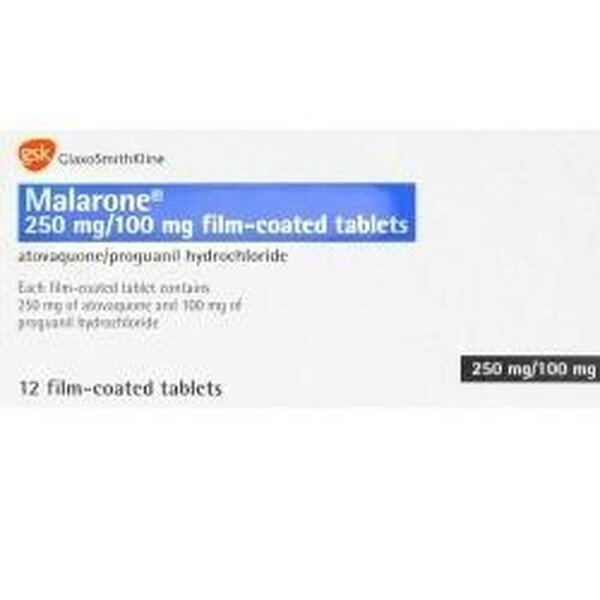
| Anti Malarials | |
Special Offers
Offers Of the Week
Clearance lines
Buy 1 get 1 Free
Best Sellers
Seasonal Specials
New Products
As Seen on TV
Bulk Buy Offers
| Lowest prices guaranteed | ||
| Free fast delivery | ||
| Confidential & discreet | ||
| 100% secure, safe & trustworthy |
||
| Thousands of satisfied customers |
||
| Run by UK Pharmacists & GP's |
||
| Genuine UK sourced medication | ||
| more » | ||
MALARONE is 98%effective in preventing infection with Plasmodium falciparum, the parasite species that is responsible for most malaria deaths. It is approved for use, even in areas where chloroquine resistance has been reported. MALARONE has been recommended by the Centers for Disease Control and Prevention (CDC) as an option for the prevention of P. falciparum malaria. MALARONE works by defending your body against infection in both your liver and blood where MALARONE then kills the malaria parasites.
Malaria is spread from the bite of a mosquito. When a mosquito bites an infected person, it ingests the malaria parasites found in that person's blood. After one week or more, the mosquito can spread the parasite to other people. After a bite from an infected mosquito, the parasite enters the person's bloodstream and travels to the liver where it grows and multiplies. During this time when the parasite is in the liver, there are no visible symptoms and the victim doesn't feel sick.
The parasite may stay in the liver for a period as short as 8 days or as long as several months to years. After it leaves the liver, it enters red blood cells and continues to grow and multiply. The red blood cells burst, freeing the parasites to attack other red blood cells. It is during this time that symptoms of malaria may begin to surface.
MALARONE provides easy, once-daily dosing and a shorter duration in treatment time, so you can concentrate on your trip, not your treatment.

|
|
|
There may be a different type of Malarone tablet available for children in your country.
To prevent malaria in adults:
• start taking Malarone 1 to 2 days before travelling to an area which has malaria
• continue taking it every day during your stay
• continue taking it for another 7 days after your return to a malaria-free area.
• 11-20 kg – 1 tablet once a day for 3 days
• 21-30 kg – 2 tablets once a day for 3 days
• 31-40 kg – 3 tablets once a day for 3 days
• over 40 kg – dose as for adults.
| 2. QUALITATIVE AND QUANTITATIVE COMPOSITION |
|
Each Malarone tablet contains: Atovaquone 250mg Proguanil hydrochloride 100mg For a full list ofexcipients, see section 6.1. |
4.1 Therapeutic indications |
|
Malarone is a fixed dose combination of atovaquone and proguanil hydrochloride which acts as a blood schizonticide and also has activity against hepatic schizonts of Plasmodium falciparum. It is indicated for: Prophylaxis of Plasmodium falciparum malaria. Treatment of acute, uncomplicated Plasmodium falciparum malaria. Because Malarone is effective against drug sensitive and drug resistant P. falciparum it is especially recommended for prophylaxis and treatment of P. falciparum malaria where the pathogen may be resistant to other antimalarials. Official guidelines and local information on the prevalence of resistance to antimalarial drugs should be taken into consideration. Official guidelines will normally include WHO and public health authorities guidelines. |
4.2 Posology and method of administration |
Method of administrationThe daily dose should be taken with food or a milky drink (to ensure maximum absorption) at the same time each day. If patients are unable to tolerate food, Malarone should be administered, but systemic exposure of atovaquone will be reduced. In the event of vomiting within 1 hour of dosing a repeat dose should be taken. Posology• Prophylaxis:Prophylaxis should • commence 24 or 48 hours prior to entering a malaria-endemic area, • continue during the period of the stay, which should not exceed 28 days,• continue for 7 days after leaving the area. In residents (semi-immune subjects) of endemic areas, the safety and effectiveness of Malarone has been established in studies of up to 12 weeks. Dosage in AdultsOne Malarone tablet daily. Malarone tablets are not recommended for malaria prophylaxis in persons under 40kg bodyweight. • Treatment:Dosage in AdultsFour Malarone tablets as a single dose for three consecutive days. Dosage in Children11-20kg bodyweight. One tablet daily for three consecutive days. 21-30kg bodyweight. Two tablets as a single dose for three consecutive days. 31-40kg bodyweight. Three tablets as a single dose for three consecutive days. >40kg bodyweight. Dose as for adults. Dosage in the ElderlyA pharmacokinetic study indicates that no dosage adjustments are needed in the elderly (See Section 5.2). Dosage in Hepatic ImpairmentA pharmacokinetic study indicates that no dosage adjustments are needed in patients with mild to moderate hepatic impairment. Although no studies have been conducted in patients with severe hepatic impairment, no special precautions or dosage adjustment are anticipated (See Section 5.2). Dosage in Renal ImpairmentPharmacokinetic studies indicate that no dosage adjustments are needed in patients with mild to moderate renal impairment. In patients with severe renal impairment (creatinine clearance <30mL/min) alternatives to Malarone for treatment of acute P. falciparum malaria should be recommended whenever possible (See Sections 4.4 and 5.2). For prophylaxis of P. falciparum malaria in patients with severe renal impairment see Section 4.3. |
4.3 Contraindications |
|
Malarone is contra-indicated in individuals with known hypersensitivity to atovaquone or proguanil hydrochloride or any component of the formulation. Malarone is contra-indicated for prophylaxis of P. falciparum malaria in patients with severe renal impairment (creatinine clearance <30mL/min). |
4.4 Special warnings and precautions for use |
|
The safety and effectiveness of Malarone (atovaquone 250mg/proguanil hydrochloride 100mg tablets) for prophylaxis of malaria in patients who weigh less than 40kg has not been established. Persons taking Malarone for prophylaxis or treatment of malaria should take a repeat dose if they vomit within 1 hour of dosing. In the event of diarrhoea, normal dosing should be continued. Absorption of atovaquone may be reduced in patients with diarrhoea or vomiting, but diarrhoea or vomiting was not associated with reduced efficacy in clinical trials of Malarone for malaria prophylaxis. However, as with other antimalarial agents, subjects with diarrhoea or vomiting should be advised to continue to comply with personal protection measures (repellants, bednets). In patients with acute malaria who present with diarrhoea or vomiting, alternative therapy should be considered. If Malarone is used to treat malaria in these patients, parasitaemia should be closely monitored. The safety and effectiveness of Malarone (atovaquone 250mg/proguanil hydrochloride 100mg tablets) for treatment of malaria in paediatric patients who weigh less than 11kg has not been established. Malarone has not been evaluated for the treatment of cerebral malaria or other severe manifestations of complicated malaria including hyperparasitaemia, pulmonary oedema or renal failure. Parasite relapse occurred commonly when P. vivax malaria was treated with Malarone alone. Travellers with intense exposure to P. vivax or P. ovale, and those who develop malaria caused by either of these parasites, will require additional treatment with a drug that is active against hypnozoites. In the event of recrudescent infections due to P. falciparum after treatment with Malarone, or failure of chemoprophylaxis, patients should be treated with a different blood schizonticide. Parasitaemia should be closely monitored in patients receiving concurrent metoclopramide or tetracycline (See Section 4.5). The concomitant administration of Malarone and rifampicin or rifabutin is not recommended (See Section 4.5). In patients with severe renal impairment (creatinine clearance < 30mL/min) alternatives to Malarone for treatment of acute P. falciparum malaria should be recommended whenever possible (See Sections 4.2, 4.3 and 5.2). |
4.5 Interaction with other medicinal products and other forms of interaction |
|
Proguanil may potentiate the anticoagulant effect of warfarin and other coumarin based anticoagulants. The mechanism of this potential drug interaction has not been established. Caution is advised when initiating or withdrawing malaria prophylaxis or treatment with atovaquone-proguanil in patients on continuous treatment with coumarin based anticoagulants. Concomitant treatment with metoclopramide and tetracycline have been associated with significant decreases in plasma concentrations of atovaquone (See Section 4.4). Concomitant administration of atovaquone and indinavir results in a decrease in the Cmin of indinavir (23% decrease; 90% CI 8-35%). Caution should be exercised when prescribing atovaquone with indinavir due to the decrease in the trough levels of indinavir. Concomitant administration of rifampicin or rifabutin is known to reduce atovaquone levels by approximately 50% and 34%, respectively. (See Section 4.4). Atovaquone is highly protein bound (>99%) but does not displace other highly protein bound drugs in vitro, indicating significant drug interactions arising from displacement are unlikely. |
4.6 Pregnancy and lactation |
|
The safety of atovaquone and proguanil hydrochloride when administered concurrently for use in human pregnancy has not been established and the potential risk is unknown. Animal studies showed no evidence for teratogenicity of the combination. The individual components have shown no effects on parturition or pre- and post-natal development. Maternal toxicity was seen in pregnant rabbits during a teratogenicity study (See Section 5.3). The use of MALARONE in pregnancy should only be considered if the expected benefit to the mother outweighs any potential risk to the foetus. The proguanil component of MALARONE acts by inhibiting parasitic dihydrofolate reductase. There are no clinical data indicating that folate supplementation diminishes drug efficacy. For women of childbearing age receiving folate supplements to prevent neural tube birth defects, such supplements should be continued while taking MALARONE. LactationThe atovaquone concentrations in milk, in a rat study, were 30% of the concurrent atovaquone concentrations in maternal plasma. It is not known whether atovaquone is excreted in human milk. Proguanil is excreted in human milk in small quantities. Malarone should not be taken by breast-feeding women. |
4.7 Effects on ability to drive and use machines |
|
Dizziness has been reported. Patients should be warned that if affected they should not drive, operate machinery or take part in activities where this may put themselves or others at risk. |
4.8 Undesirable effects |
|
The following table provides a summary of adverse reactions reported with Malarone, atovaquone or proguanil in clinical trials and spontaneous post-marketing reports. The following convention is used for the classification of frequency: very common ( In clinical trials of atovaquone-proguanil for treatment of malaria, the most commonly reported adverse events, independent of attributability, were abdominal pain, headache, anorexia, nausea, vomiting, diarrhoea and coughing, and were generally reported in a similar proportion of patients receiving atovaquone-proguanil or a comparator antimalarial drug. In clinical trials of atovaquone-proguanil for prophylaxis of malaria, the most commonly reported adverse events, independent of attributability, were headache, abdominal pain and diarrhoea, and were reported in a similar proportion of subjects receiving atovaquone-proguanil or placebo.
1. Frequency calculated from Malarone clinical trials 2. Frequency taken from atovaquone label. Patients participating in clinical trials with atovaquone have received higher doses and have often had complications of advance Human Immunodeficiency Virus (HIV) disease. Therefore, the causal relationship between the adverse experiences and atovaquone is difficult to evaluate. These events may have been seen at a lower frequency or not at all in clinical trials with atovaquone-proguanil. 3. Observed from post-marketing spontaneous reports and the frequency is therefore unknown 4. Observed with proguanil and the frequency is therefore unknown. 5. Clinical trial data for atovaquone-proguanil indicated that abnormalities in liver function tests were reversible and not associated with untoward clinical events. |
4.9 Overdose |
|
There have been no reports of overdosage with Malarone. In cases of suspected overdosage symptomatic and supportive therapy should be given as appropriate. |
5.1 Pharmacodynamic properties |
Pharmacotherapeutic Group: AntimalarialsATC Code: P01B B51 Mode of ActionThe constituents of Malarone, atovaquone and proguanil hydrochloride, interfere with two different pathways involved in the biosynthesis of pyrimidines required for nucleic acid replication. The mechanism of action of atovaquone against P. falciparum is via inhibition of mitochondrial electron transport, at the level of the cytochrome bc1 complex, and collapse of mitochondrial membrane potential. One mechanism of action of proguanil, via its metabolite cycloguanil, is inhibition of dihydrofolate reductase, which disrupts deoxythymidylate synthesis. Proguanil also has antimalarial activity independent of its metabolism to cycloguanil, and proguanil, but not cycloguanil, is able to potentiate the ability of atovaquone to collapse mitochondrial membrane potential in malaria parasites. This latter mechanism may explain the synergy seen when atovaquone and proguanil are used in combination. MicrobiologyAtovaquone has potent activity against Plasmodium spp (in vitro IC50 against P. falciparum 0.23-1.43 ng/mL). Atovaquone is not cross-resistant with any other antimalarial drugs in current use. Among more than 30 P. falciparum isolates, in vitro resistance was detected against chloroquine (41% of isolates), quinine (32% of isolates), mefloquine (29% of isolates), and halofantrine (48% of isolates) but not atovaquone (0% of isolates). The antimalarial activity of proguanil is exerted via the primary metabolite cycloguanil (in vitro IC50 against various P. falciparum strains of 4-20 ng/mL; some activity of proguanil and another metabolite, 4-chlorophenylbiguanide, is seen in vitro at 600-3000 ng/mL). In in vitro studies of P. falciparum the combination of atovaquone and proguanil was shown to be synergistic. This enhanced efficacy was also demonstrated in clinical studies in both immune and non-immune patients. |
5.2 Pharmacokinetic properties |
|
There are no pharmacokinetic interactions between atovaquone and proguanil at the recommended dose. In clinical trials, where children have received Malarone dosed by body weight, trough levels of atovaquone, proguanil and cycloguanil in children are generally within the range observed in adults. AbsorptionAtovaquone is a highly lipophilic compound with low aqueous solubility. In HIV-infected patients, the absolute bioavailability of a 750 mg single dose of atovaquone tablets taken with food is 23% with an inter-subject variability of about 45%. Dietary fat taken with atovaquone increases the rate and extent of absorption, increasing AUC 2-3 times and Cmax 5 times over fasting. Patients are recommended to take Malarone tablets with food or a milky drink (See Section 4.2). Proguanil hydrochloride is rapidly and extensively absorbed regardless of food intake. DistributionApparent volume of distribution of atovaquone and proguanil is a function of bodyweight. Atovaquone is highly protein bound (> 99%) but does not displace other highly protein bound drugs in vitro, indicating significant drug interactions arising from displacement are unlikely. Following oral administration, the volume of distribution of atovaquone in adults and children is approximately 8.8 L/Kg. |
![]() |
||||
| ||||
| ||||
| ||||
| ||||
| ||||
| more » | ||||
![]() |
| “Dear Chemist Direct - I'd like to say thanks for saving me over £60 on the products I ordered from you last week. The savings are amazing compared to Boots. I've been telling all my friends and colleagues about you and the savings you offer. Delivery was fast and the products were spot on. Thanks!”
John Stephens, Surrey
|
Categories: Embarrassing Conditions | Medicines | Sexual Health | Health | Toiletries | Vitamins | Beauty | For Men | Fragrances | Offers
Key Brands: Solpadeine | Regaine | Nicorette | Nurofen | Anadin | Clarins | Lynx | Canesten | Sanatogen
Common Search: Top Searches | Hairloss Products | Cold Products | Perfumes | Makeup | Skincare | Thrush Creams | Headache Tablets
|
|
|||
| © 2008 Chemist Direct.co.uk. All Rights Reserved. | ||||