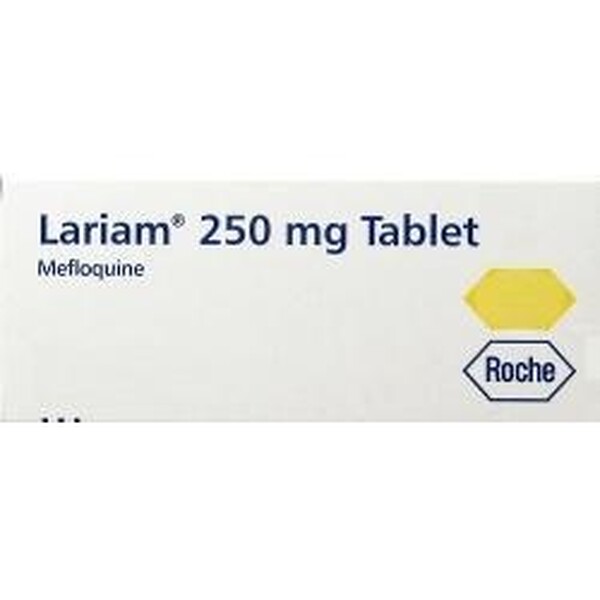
Lariam (Mefloquine) Tablets: Lariam is an anti-malarial. It contains the active ingredient mefloquine. It is is used for the treatment of malaria and to help prevent you from catching malaria. What is Malaria? Malaria is a life threatening disease and a major health risk for travellers visiting tropical countries. It occurs when small parasites are passed from one person to another by the bites of certain mosquitoes. The tablets are especially useful if you are travelling to countries where there is a type of malaria which is particularly difficult to treat. No single medicine is effective against all malaria parasites. The choice of a particular medicine depends on the sensitivity of the malaria parasites found in the area to be visited. Your doctor will advise you whether Lariam is suitable for the area to which you wish to go. To help minimise your chance of catching the disease it is important that you read this information carefully. Ask your doctor to explain anything you do not understand.
Lariam (Mefloquine) Tablets: Always take the tablets as instructed by your doctor. This will depend on whether you are taking the tablets for prevention or treatment of malaria. Take the tablets with plenty of water, and preferably with food. Swallow the tablets whole, do not suck or chew them. If you take too many tablets or someone else accidentally takes your medicine, contact your doctor, pharmacist or nearest hospital straight away.
Malaria preventionPlease read the following section if you are taking the tablets to help prevent you from catching malaria.
- The tablets should be taken once weekly, always on the same day.
- You should start taking the tablets at least 1 week and up to 2 - 3 weeks before departure. You should continue taking the tablets throughout your stay and for 4 weeks after your return. If you forget to take a dose, take one as soon as you remember, then go on as before.
- For effective prevention you must take the full course of tablets.
- No anti-malarial tablets are completely effective. Malaria can occur during or after preventative medication. If you develop a fever or flu-like symptoms during your travels or within 2 to 3 months after you leave the malarious area, check with a doctor immediately.
Below is an example which gives the recommended dose for a 2-week stay in an area where malaria is present:
Adult dose:
Before travel
at least one week one tablet weekly
during travel
- week 2 - dose = 1
- week 3 - dose = 1
on return
- week 4 - dose = 1
- week 5 - dose = 1
- week 6 - dose = 1
- week 7 - dose = 1
A pack of 8 tablets is enough to help prevent you from catching malaria if you are staying for 3 weeks in an area where malaria is present and if you start taking the tablets 1 week before departure. If your stay is longer than 3 weeks or if your doctor has advised that you should start taking your tablets 2 to 3 weeks before departure, you will need a second pack.
Children's dose: The tablets are not recommended for children under 3 months of age, i.e., those who weigh less than 5kg (11lbs). For children over this weight, the dose is shown in the table below. The tablets can be divided by breaking along the score lines. As in adults, the dose should be taken once weekly on the same day, and continued for 4 weeks after return.
- Weight: 5 - 19kg (11 - 42lbs) Age: (Approx) 3 months - 5 years Dose: ¼ tablet
- Weight: 20 - 30kg (44 - 66lbs) Age: (Approx) 6 - 8 years Dose:½ tablet
- Weight: 31 - 45kg (68 - 99lbs) Age: (Approx) 9 - 14 years Dose:¾ tablet
Lariam (Mefloquine) Tablets:
When Lariam should not be used: - If you suffer from or have ever suffered from fits, mental complaints or severe changes of mood (such as depression), you should not take Lariam for the prevention of malaria.
- If you have severe liver problems.
- If you are pregnant or breast-feeding, unless your doctor tells you to take Lariam.
- If you are allergic to Lariam, any of the ingredients it contains or to similar medicines such as quinine or chloroquine.
- If you are also taking any other anti-malarial medicines such as quinine, quinidine or chloroquine.
- If you have recently (in the last 3 days) received an oral vaccine to help prevent you from catching typhoid or similar diseases as taking Lariam may stop the vaccine from working properly.
When should you be extra careful while taking Lariam?
Make sure your doctor knows if you:
- have a history of psychiatric illness
- have heart trouble
- are taking any medicines for heart trouble, high blood pressure; blood clotting disorders or diabetes; antihistamines for allergy; tricyclic antidepressants; phenothiazines, used for treatment of some psychiatric disorders, or any medicine for the treatment of epilepsy (e.g. sodium valproate, carbamazepine, phenobarbital, phenytoin).
- have kidney problems
- If you have been told by your doctor that you have an intolerance to some sugars, contact your doctor before taking this medicine
You should carefully read all product packaging and labels prior to use
Lariam (Mefloquine) Tablets contain the active ingredient mefloquine. - Each tablet contains 250mg of mefloquine (as mefloquine hydrochloride).
- The tablets also contain poloxamer, microcrystalline cellulose, lactose, maize starch, crospovidone, ammonium calcium alginate, talc, magnesium stearate.
Lariam (Mefloquine) Tablets:If you are concerned about any unwanted effects please seek medical advice as soon as possible.
Most common unwanted effects: feeling or actually being sick, dizziness, vertigo, loss of balance, headache, sleepiness, sleep problems, diarrhoea, stomach ache. If you feel dizzy, do not drive or carry out tasks requiring a high degree of co-ordination.
Less common unwanted effects:Effects on nervous system: psychiatric reactions which may be disabling and last for more than several weeks. These include unusual changes in mood or behaviour, feelings of worry or anxiety, depression, feelings of persecution, crying, aggression, restlessness, forgetfulness, agitation, confusion, panic and hallucinations. If you experience any of these effects you should immediately stop taking Lariam and consult a doctor.
Other effects: feeling of weakness, breathlessness, muscle cramps, joint pains, muscle pains, tiredness, fever or chills, sweating, loss of appetite, indigestion, a change in the level of certain factors (e.g. white blood cells, platelets, enzymes) in your blood. There have also been rare reports of allergic reactions.
Lariam (Mefloquine) Tablets - Patient Information Leaflet
1. What Lariam is
Lariam is an anti-malarial. It contains the active ingredient mefloquine. Each tablet contains 250mg of mefloquine (as mefloquine hydrochloride). The tablets also contain poloxamer, microcrystalline cellulose, lactose, maize starch, crospovidone, ammonium calcium alginate, talc, magnesium stearate. The tablets are white and are cross-scored.
2. What Lariam is used for
This medicine is used for the treatment of malaria and to help prevent you from catching malaria. Malaria is a life threatening disease and a major health risk for travellers visiting tropical countries. It occurs when small parasites are passed from one person to another by the bites of certain mosquitoes. The tablets are especially useful if you are travelling to countries where there is a type of malaria which is particularly difficult to treat. No single medicine is effective against all malaria parasites. The choice of a particular medicine depends on the sensitivity of the malaria parasites found in the area to be visited. Your doctor will advise you whether Lariam is suitable for the area to which you wish to go.
To help minimise your chance of catching the disease it is important that you read this leaflet carefully. Ask your doctor to explain anything you do not understand.
3. When Lariam should not be used
- If you suffer from or have ever suffered from fits, mental complaints or severe changes of mood (such as depression), you should not take Lariam for the prevention of malaria.
- If you have severe liver problems.
- If you are pregnant or breast-feeding, unless your doctor tells you to take Lariam.
- If you are allergic to Lariam, any of the ingredients it contains or to similar medicines such as quinine or chloroquine.
- If you are also taking any other anti-malarial medicines such as quinine, quinidine or chloroquine.
- If you have recently (in the last 3 days) received an oral vaccine to help prevent you from catching typhoid or similar diseases as taking Lariam may stop the vaccine from working properly.
-
When should you be extra careful while taking Lariam?
Make sure your doctor knows if you:
- have a history of psychiatric illness
- have heart trouble
- are taking any medicines for heart trouble, high blood pressure; blood clotting disorders or diabetes; antihistamines for allergy; tricyclic antidepressants; phenothiazines, used for treatment of some psychiatric disorders, or any medicine for the treatment of epilepsy (e.g. sodium valproate, carbamazepine, phenobarbital, phenytoin).
- have kidney problems
- If you have been told by your doctor that you have an intolerance to some sugars, contact your doctor before taking this medicine
Halofantrine (which is used to treat malaria) and Lariam taken at the same time can slow the heart beat to a dangerous level. Therefore, to help avoid the possibility of a heart attack, you must not take halofantrine if you are already taking, or have recently taken, Lariam.
May Lariam be used during pregnancy or while breast-feeding?
If you are a woman of child-bearing age, you should take reliable contraceptive precautions whilst you are taking Lariam and for 3 months after the last dose.
Normally pregnant women should not take these tablets. It is important to tell your doctor if you are pregnant or think you could be pregnant, as she or he may decide that you should not use this medicine.
If you are taking these tablets it is recommended that you do not breast-feed.
4. How to take Lariam
Always take the tablets as instructed by your doctor. This will depend on whether you are taking the tablets for prevention or treatment of malaria. Take the tablets with plenty of water, and preferably with food. Swallow the tablets whole, do not suck or chew them. If you take too many tablets or someone else accidentally takes your medicine, contact your doctor, pharmacist or nearest hospital straight away.
Malaria prevention
Please read the following section if you are taking the tablets to help prevent you from catching malaria.
Important
- The tablets should be taken once weekly, always on the same day.
- You should start taking the tablets at least 1 week and up to 2 - 3 weeks before departure. You should continue taking the tablets throughout your stay and for 4 weeks after your return. If you forget to take a dose, take one as soon as you remember, then go on as before.
- For effective prevention you must take the full course of tablets.
- No anti-malarial tablets are completely effective. Malaria can occur during or after preventative medication. If you develop a fever or flu-like symptoms during your travels or within 2 to 3 months after you leave the malarious area, check with a doctor immediately.
Below is an example which gives the recommended dose for a 2-week stay in an area where malaria is present:
Adult dose:
Before travel
at least one week
one tablet weekly
during travel
- week 2 - dose = 1
- week 3 - dose = 1
on return
- week 4 - dose = 1
- week 5 - dose = 1
- week 6 - dose = 1
- week 7 - dose = 1
A pack of 8 tablets is enough to help prevent you from catching malaria if you are staying for 3 weeks in an area where malaria is present and if you start taking the tablets 1 week before departure. If your stay is longer than 3 weeks or if your doctor has advised that you should start taking your tablets 2 to 3 weeks before departure, you will need a second pack.
Adults weighing less than 45kg (99lbs) should take the children's dose (see below).
Whether you are an adult or a child you should not take the tablets for more than 12 months.
Children's dose:
The tablets are not recommended for children under 3 months of age, i.e., those who weigh less than 5kg (11lbs). For children over this weight, the dose is shown in the table below. The tablets can be divided by breaking along the score lines. As in adults, the dose should be taken once weekly on the same day, and continued for 4 weeks after return.
- Weight: 5 - 19kg (11 - 42lbs) Age: (Approx) 3 months - 5 years Dose: ¼ tablet
- Weight: 20 - 30kg (44 - 66lbs) Age: (Approx) 6 - 8 years Dose: ½ tablet
- Weight: 31 - 45kg (68 - 99lbs) Age: (Approx) 9 - 14 years Dose: ¾ tablet
Malaria treatment
Please read the following section if you are taking the tablets to treat malaria.
Your doctor will tell you how much medicine you need to take. This will depend on your weight and whether you have been living in a malarious area. Normally, you should not receive more than 6 tablets in total.
You should not be given Lariam to treat malaria if you have previously caught the disease whilst taking this medicine for its prevention.
5. Possible unwanted effects of Lariam
If you are being treated for malaria, any unwanted effects of treatment may be similar to some of the symptoms of malaria itself.
If you are concerned about any unwanted effects please seek medical advice as soon as possible but before taking your next tablet. If necessary, the doctor may advise you to stop taking Lariam and take an alternative antimalarial agent.
Lariam can stay in the body for a long time after taking the last dose and therefore some adverse reactions may occur or persist for more than several weeks.
Most common unwanted effects: feeling or actually being sick, dizziness, vertigo, loss of balance, headache, sleepiness, sleep problems, diarrhoea, stomach ache. If you feel dizzy, do not drive or carry out tasks requiring a high degree of co-ordination.
Less common unwanted effects:
Effects on nervous system: psychiatric reactions which may be disabling and last for more than several weeks. These include unusual changes in mood or behaviour, feelings of worry or anxiety, depression, feelings of persecution, crying, aggression, restlessness, forgetfulness, agitation, confusion, panic and hallucinations. If you experience any of these effects you should immediately stop taking Lariam and consult a doctor.
Other neurological reactions include fits, "pins and needles", weakness, visual disturbances, ringing in the ears, hearing impairment, co-ordination problems and shaking of the hands and fingers. There have also been rare reports of suicidal tendencies and suicide.
Effects on circulation: changes to blood pressure or heart rate, palpitations (awareness or thumping of your heart beat), chest pain.
Effects on skin/scalp: fluid retention, skin rash, itching, hair loss. In rare cases, skin reactions may be serious.
Other effects: feeling of weakness, breathlessness, muscle cramps, joint pains, muscle pains, tiredness, fever or chills, sweating, loss of appetite, indigestion, a change in the level of certain factors (e.g. white blood cells, platelets, enzymes) in your blood. There have also been rare reports of allergic reactions.
6. How to store Lariam
- The tablets should be stored in a dry place.
- Store in the original package to protect from moisture.
- Keep this medicine out of the reach and sight of children. Return any left over medicine to your pharmacist. Only keep it if your doctor tells you to.
- Remember this medicine is for you. Only a doctor can prescribe it for you. Never give it to others. It may harm them even if their symptoms are the same as yours.
- The medicine must not be used after the date (EXP) printed on the pack.
7. Further information:
You can get more information on Lariam from your doctor or pharmacist.
It is essential that you follow the recommendations given for taking the tablets. Although no preventative medication is 100% effective, the following important activities together with preventative medication will substantially reduce the risk of catching malaria:
- Make sure you sleep in a room that is screened against mosquitoes or that you use a mosquito net (preferably one that has been treated with an insect repellent) over the bed.
- Use insect repellents; ointments, lotions and sprays, to deter mosquitoes.
- In the evening, cover arms and legs with light-coloured, long-sleeved clothes and trousers, and use an insect repellent. Anklets are also available which have been treated with repellent.
- Vaporising electric "mats", mosquito coils or tablets can be used at night-time around exposed areas of the body (ankles and feet).
UK Mainland - Free Delivery To UK Mainland
On All Orders Over £ 40 In Value.
Standard Delivery 1-3 days from despatch
For orders under £40 in value we charge £3.49 for UK delivery. This is the total cost of delivery and packaging, regardless of how many items you order. We use a combination of couriers and services depending on location, contents and the weight of your order, this is due to the dangerous goods act introduced in January 2013 by the Civil Aviation Authority. We know service is important to you so have chosen our partners carefully and include both signed for and standard deliveries from Parcel Force, Hermes and Royal Mail, details will be included in the despatch conformation you receive. The vast majority of orders (over 98%) are despatched either on the same working day or the following working day (Mon-Sat including Bank Holidays). A signature may be required on receipt for heavy orders. For orders that weigh 25kgs or more (and for every subsequent 25kgs) there is an additional handling charge of £3.49 per 25kg. All other delivery conditions apply as above.

Europe - Delivery Charge from £ 3.95
Delivery charges to Europe are shown at checkout dependent on the weight of your parcel and destination. Delivery is usually within 3-10 days from dispatch. Certain product and weight restrictions apply.
Americas & Rest Of The World - Delivery Charge from £ 4.25
Delivery charges to regions outside of Europe are shown at checkout dependent on the weight of your parcel and destination. Delivery is usually 5-15 days from dispatch. All prices shown online include VAT At checkout VAT (
20 %) will be deducted where applicable.
Note: Certain weight and product restrictions apply.
|